
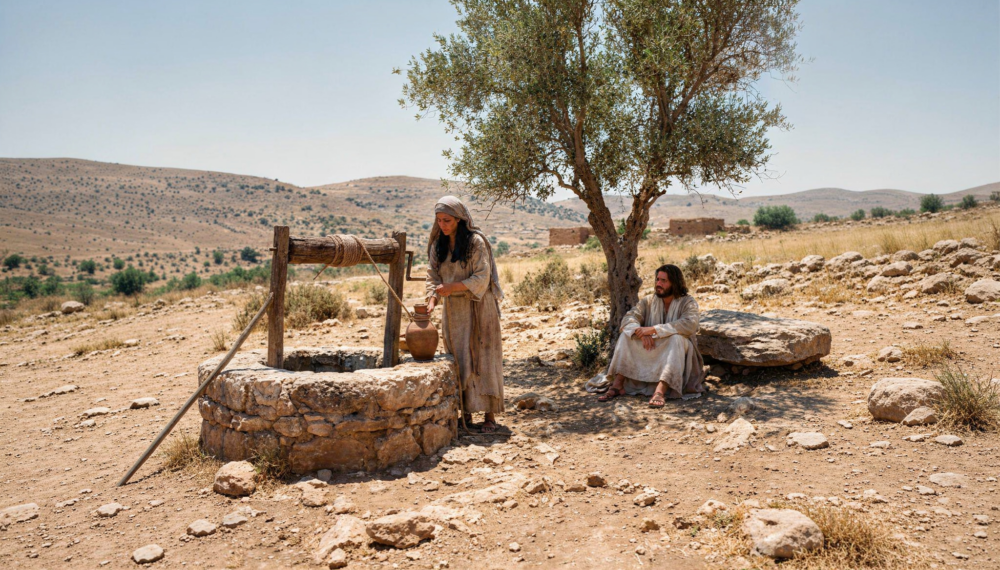
In the dusty landscape of Sychar, an ancient piece of property served as the backdrop for one of the most profound theological reconciliations in history. To the casual reader, Jesus’ encounter with the Samaritan woman is a story of personal redemption. However, when traced through the lens of the Old Testament, it is revealed as a legal and spiritual homecoming for the “Lost Tribes” of Israel.
The Foundation: Jacob’s Foothold
The story begins in Genesis 33, when the patriarch Jacob returned to the land of Canaan. In an act of faith, he purchased a “parcel of a field” near Shechem for 100 pieces of silver. This wasn’t just land; it was a stake in the promise God had made to his grandfather, Abraham. On his deathbed, Jacob bypassed his eldest sons and gave this specific portion to Joseph, the son of his beloved wife Rachel, as a “double portion” of his inheritance (Genesis 48).
Centuries later, after the Exodus, the Israelites carried Joseph’s bones back to this very plot (Joshua 24). The land became the heart of the territory for Ephraim, Joseph’s son, and stood as a symbol of the birthright and the continuity of the House of Israel.
The Rupture: The Adultery of Samaria
The narrative took a dark turn in 722 BC when the Northern Kingdom (Israel/Samaria) fell to the Assyrians. The conquerors deported the Israelites and resettled the land with people from five foreign nations (2 Kings 17:24). These settlers—from Babylon, Cuthah, Hamath, Ivvah, and Sepharvaim—brought with them five foreign gods (their spiritual “husbands”).
The resulting Samaritan population was a “mixed” people, both ethnically and spiritually. They attempted to worship the God of Israel alongside these five foreign deities. In the eyes of the prophets, Samaria became the “unfaithful wife” who had abandoned her true husband (God) for the lovers of the nations. As Hosea 2 prophesied, she was no longer “My Wife,” and God was no longer her “Husband.”
The Encounter: The True Bridegroom at the Well
When Jesus arrived at Jacob’s Well in John 4, He was not there by accident. In the Old Testament, wells were the traditional “meeting places” where brides were found (Isaac and Rebekah, Jacob and Rachel). By sitting at the well, Jesus was positioning Himself as the Divine Bridegroom looking for His scattered bride.
When Jesus told the woman, “You have had five husbands, and the one you have now is not your husband,” He was speaking a double truth. He was addressing her personal life, but He was also indicting the entire history of Samaria:
- The Five Husbands: Represented the five pagan nations and their gods that had historically occupied the land.
- The Current “Non-Husband”: Represented the Samaritans’ illegitimate worship. They were “living with” the God of Jacob but were not in a true covenant relationship with Him. As Jesus noted, they “worshipped what they did not know.”
The Resolution: Living Water and New Wine
The woman immediately recognised the weight of the conversation, shifting the topic to Mount Gerizim. This mountain, visible from the well, was where the Samaritans had built their own temple. It was the final wall of separation between the two houses of Israel.
Jesus’ response tore down that wall. He offered her “Living Water”—a gift that bypassed the need for Jacob’s physical well and the old religious arguments. He declared that the hour had come when neither mountain would matter. The “lost sheep” of the House of Israel were being called back to a relationship in Spirit and Truth.
The Full Circle
The plot of ground Jacob gave to Joseph finally came full circle. The land that saw the birthright given, the bones of Joseph buried, and the idolatry of the five nations flourish, finally saw the arrival of the Messiah.
The woman left her water jar—a symbol of her old life and the old well—to tell her people that the True Husband of Israel had finally come home. In the span of a single afternoon, the “divorced” and “lost” tribes of the North were invited back into the family, proving that what Jacob bought with silver, Jesus redeemed with grace.