



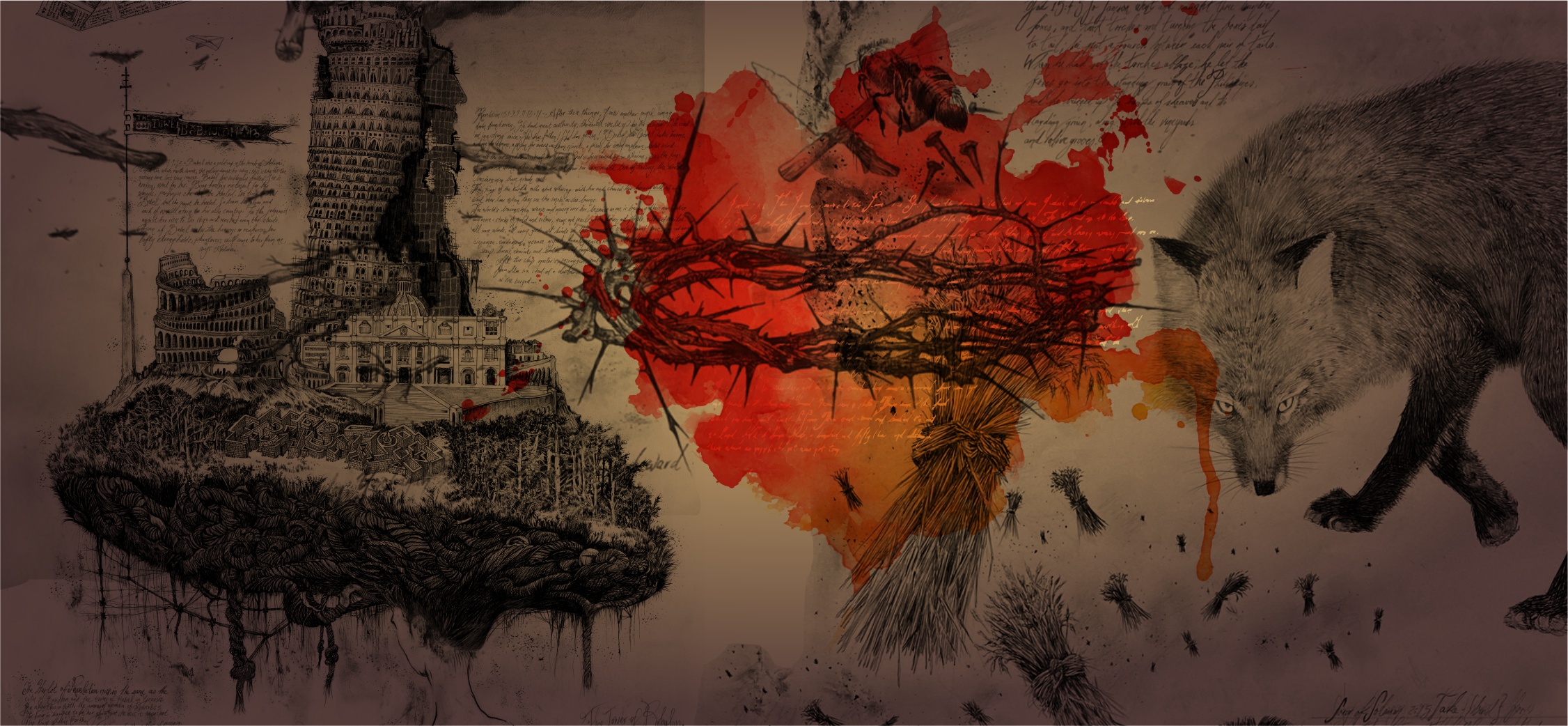
Cloud7 grew from a desire to see the Bible differently
For many of us, the Bible comes to us as a collection of stories, teachings, traditions and beliefs — often separated from the world in which they were written and from the centuries that followed. But what happens when we step back and look at the Big Picture? What happened? Where does it fit? How did we get from there to here?
And how much of what we believe comes from Scripture — and how much has been shaped by history, tradition and assumption?
This is my place to explore those questions.
Sometimes that means researching Scripture and history. Sometimes it means examining ideas the Church has inherited. Sometimes it means following a question wherever the evidence leads. I began this journey because I wanted to understand what the Bible actually says — beneath the layers of teaching, tradition and assumption that can accumulate over time.
The goal isn’t to replace one system of belief with another. It is to look again. To put the evidence on the table. To ask better questions. To recognise where interpretation begins. And, above all, to keep the wonder of Scripture alive.
Because truth is not something we manufacture to fit our beliefs. Truth is a Person.
This is the wider world where that journey takes place.
WONDERFUL WORLD OF GOD'S word
One story. Many ways of seeing it.
BIBLE & THEOLOGY
Questions worth asking. Truth worth pursuing. Scripture is the starting point — but understanding it often means looking beyond a single verse or familiar teaching.
Cloud7 explores biblical language, theology, church tradition, history and the assumptions that have shaped Christian thought.
The aim is not to tell you what to think, but to put the questions, evidence and different interpretations on the table.
Ask deeper questions. Read beyond the assumptions.
THE BIBLE TIMELINE PROJECT
See the Bible unfold across time.
The Bible Timeline Project grew from the realisation that many people struggle with Scripture because they cannot see the Big Picture.
The Atlas brings biblical chronology, geography, genealogies, Church history and world history together in one visual research system.
From Creation to New Creation, isolated stories become part of one unfolding story.
The timeline is the visual representation.
Cloud7's articles are the verbal colouring pens.
See the Bible as one, wonderful story.
DRAWN to the WORD
Sketches from Scripture.
Sometimes a drawing can make you notice something that words alone leave hidden.
Drawn to the Word began as a love for Scripture expressed through drawing — exploring details, symbols, emotions and connections that can easily pass unnoticed when we simply read the text.
These are not illustrations created merely to decorate a story.
They are visual sermons — invitations to stop, look again and discover another layer of meaning.
Revealing hidden layers of Scripture, one drawing at a time.
Explore the Research
These articles dive into historical, cultural, and theological insights that bring Scripture to life.

Character: The Condition of a King’s Crown

Love Your “Neighboring” Body Like Yourself

Jesus Isn’t Building a Mansion FOR You—He’s Building One IN You
Discover The Bible Timeline Project
After years of study, this timeline visually reconstructs the biblical narrative. It reveals connections often missed when reading the Bible book by book and serves as the backbone for all the articles on this site.
Famous Testimonials about the Bible
Some famous words about the Word of God

/DLMoody-615289898-28bb5a51cff44848b3cce8ec6a657413.jpg)
VERSES in the Bible
Total no of chapters
Total No of words
Infrequently Asked Questions about the Bible
The Ones You Didn't Know You Needed to Ask...
A collection of Bible-related questions & answers that might not be on everyone's mind... but are still worth exploring!
In the Bible, “testament” and “covenant” are related but not exactly the same thing.
– Covenant (Hebrew: berith, Greek: diathēkē): A solemn agreement or contract between two parties, often involving promises, conditions, and signs or symbols. Examples include the Noahic Covenant, Abrahamic Covenant, Mosaic Covenant, and New Covenant.
– Testament (Latin: testamentum, Greek: diathēkē): This word can mean either “covenant” or “will” (as in a last will and testament). In the Bible, it’s often used interchangeably with “covenant,” especially in the New Testament.
So, while “covenant” emphasizes the agreement itself, “testament” can be seen as a broader term encompassing the idea of a covenant, often with a focus on the written record of God’s relationship with humanity.
The New Covenant, made with the house of Israel and Judah (Jeremiah 31:31-34), fulfills God’s promises to His people. Through faith in Jesus, the promised Jewish Messiah, the Church is grafted into this covenant (Romans 11:11-18, Ephesians 2:11-22) and participates in its blessings.
The Law of Moses was perfect; the problem was men’s hearts that needed transformation. As we grasp God’s heart and understand the Torah, we desire His law engraved on our hearts. The New Covenant is God’s promise to transform hearts, writing His laws within them and empowering believers to live according to His desires. This covenant addresses the root issue of sinful hearts, fulfilling God’s original intent for humanity.
In essence, Jesus’ sacrifice was always the basis for salvation, even in the Old Covenant, rooted in God’s eternal plan – as the prophesied Messiah, slain before the foundation of the world (1 Peter 1:20, Revelation 13:8). The New Covenant brings a fuller revelation of this plan, applying it to all people through faith in Christ Jesus, the fulfillment of God’s promise!
Free will and free choice, from a biblical perspective, are related but distinct. Free will is the God-given capacity of human beings to make decisions and respond to God’s call, even within the limitations of our fallen nature. Free choice is the actual exercise of that will in a specific situation, such as choosing obedience, love, or faith.
Scripture shows that while humans are influenced by sin and circumstances, God still invites all to choose life (Deuteronomy 30:19) and empowers those who respond to Him (Philippians 2:13), demonstrating that our choices are meaningful within His sovereign plan.
The concepts of Hell and the Lake of Fire are often confused but have distinct origins and meanings in biblical context:
| Term | Origin | Biblical Meaning | Purpose | Timing | Occupants | Nature / Symbolism |
|---|---|---|---|---|---|---|
| Hell (Sheol / Hades / Gehenna) | Sheol & GEI-hinnom (Hebrew), Hades & Gehenna (Greek) | Temporary dwelling of the dead; Gehenna used symbolically for judgment | Interim holding place; warning of judgment | After death, before final judgment | Human dead (righteous or unrighteous); Devil & angels not present | Awaiting corrective judgment |
| Lake of Fire | Greek λίμνη τοῦ πυρός (limnē tou pyros) | Final, eternal place of punishment | Ultimate judgment; eternal purification by God | After the Last Judgment (eschatological) | Devil, his angels and humans not found in Lamb’s Book of Life | Eternal fire and brimstone; carry refining or purifying symbolism |
Immortality refers to being free from death (1 Timothy 6:16), and Scripture makes clear that only God inherently possesses this life—He alone is deathless in His essence and has life in Himself (John 5:26). For believers, immortality is not inherited by nature but is a gift God imparts (2 Timothy 1:10), enabling us to share in His life. Building on this, eternal life is more than unending existence; it is a timeless life that transcends the bounds of time and space, emphasizing the quality of life rather than merely its duration. Eternal life is defined by a deep, personal relationship with God, enjoying His presence and fellowship, and it begins at salvation. Everlasting life, in contrast, highlights the unending duration of life, focusing on its endless nature and often pointing to the life to come in the afterlife. Together, these concepts show that God’s gift to believers is not just life that cannot end, but life that is rich, meaningful, and rooted in His presence forever.
Many New Testament books emphasize that Jesus was foreordained as the Lamb to be sacrificed before the foundation of the world (e.g., Revelation 13:8, 1 Peter 1:19–20, John 17:24). From God’s eternal perspective, this sacrifice was sufficient to atone for sin, because He alone fully understands righteousness, justice, and mercy. However, humanity’s inability to grasp the weight of sin and the necessity of forgiveness required the plan to unfold in history. Jesus had to come in the flesh, entering the temporal world to fulfill the sacrificial system God instituted, which highlighted man’s failure to live holy lives (Hebrews 10:1–10). Through His life, death, and resurrection, the eternal sacrifice was made manifest in human history, allowing people to see and participate in God’s redemption, bridging the gap between God’s eternal justice and human understanding.
Yes and No – The historical Yeshua, whose name means “Yahweh saves,” was crucified in alignment with Passover and the Feast of Unleavened Bread and rose on First Fruits, fulfilling His own prophecy of the sign of Jonah: three days and three nights in the grave (Matthew 12:40). This literal fulfillment aligns with the Jewish calendar and festivals, emphasizing His Hebrew roots and the precise timing of God’s plan for redemption. In contrast, the traditional observance of Jesus being crucified on Friday and rising Sunday reflects centuries of Church tradition and symbolism, but it does not match the literal prophetic timeline. Understanding this distinction highlights the difference between the Messiah as Yeshua in history and the Messiah as Jesus in later Gentile-centered tradition, showing how God’s eternal plan unfolded both prophetically and historically.
The Bible’s story follows a clear narrative arc that begins, unfolds, and ultimately resolves with God restoring His original purpose for humanity. In Book of Genesis, humanity is created to live on the earth in fellowship with God in the Garden of Eden, where heaven and earth are closely connected and God dwells among His creation. Sin disrupts this relationship, and the biblical story then traces humanity’s long separation from God and His unfolding plan of redemption throughout history. This plan reaches its climax in Book of Revelation, where God restores what was lost: a new heaven and a new earth, with the New Jerusalem descending from heaven and God once again dwelling with humanity. The movement of the story is therefore not about humans escaping to heaven, but about creation being restored and God returning to dwell with His people. In this way the Bible forms a beautiful three-part narrative arc: Genesis — humanity living with God in Eden; History — humanity separated from God; Revelation — God restoring creation and dwelling with humanity on the New Earth.
When discussing different types of Bibles, the primary distinction lies not in translation but in the canon—the collection of books considered authoritative Scripture. Today there are three widely recognised Christian canons: Protestant, Catholic, and Orthodox. The Protestant Bible contains 66 books and follows the Hebrew Jewish canon for the Old Testament. The Catholic Bible includes 73 books, incorporating several additional texts known as the Deuterocanonical books, which were preserved in the Greek Scriptures used widely in the ancient world. The Orthodox Bible contains between 76 and 81 books, depending on the tradition, and generally relies on the Greek Septuagint as its Old Testament. However, before these later distinctions developed, the first-century believers—including the apostles and the early followers of Yeshua—primarily used the Septuagint, the Greek translation of the Hebrew Scriptures that circulated throughout the Jewish diaspora. This means the earliest Christian communities were familiar with a broader scriptural tradition than the later Protestant canon. Understanding these differences helps explain how the biblical canon developed over time and why different Christian traditions today recognise slightly different collections of books.
Summary of Major Biblical Canons
| Bible Tradition | Total Books | Old Testament Basis | Notes |
|---|---|---|---|
| First-Century Scriptures | ~50+ writings in circulation | Greek Septuagint | Scriptures commonly used by Jews of the diaspora and early believers |
| Protestant Bible | 66 | Hebrew canon | 39 OT + 27 NT; Apocrypha generally excluded |
| Catholic Bible | 73 | Septuagint + Hebrew | Includes Deuterocanonical books such as Tobit, Judith, and Maccabees |
| Orthodox Bible | 76–81 | Septuagint tradition | Includes additional books like 3 Maccabees and Psalm 151 |
This overview shows that the New Testament canon is the same across all traditions (27 books), while the main differences arise in the Old Testament collection of writings.
The Bible and historical evidence strongly suggest that Yeshua did not intend to start a new religion. He came as the Jewish Messiah to fulfil God’s promises to Israel, calling His own people back to covenant faithfulness. His teachings, miracles, and parables were rooted in Jewish law and tradition, emphasising continuity rather than creating a separate faith. Yeshua’s central message focused on the Kingdom of God, a spiritual and moral reality inviting Israel to repent, return to God, and experience salvation. As Paul explains in Romans 11, Gentiles were included as wild branches grafted into the covenantal tree, highlighting that the faith was originally centred on Israel and that Gentile participation was by God’s design, not Yeshua’s initial intent. While Christianity eventually became institutionalised over time, Yeshua’s purpose was always to restore Israel and fulfil prophecy, not to found a new religious system.
The gospel is the good news that humanity, once separated from God through sin and subject to death, has been rescued and restored by God’s grace. Unable to save ourselves by keeping the law or earning righteousness, we stood in utter need of God’s initiative to heal what was broken and reconcile us to Himself. Through this, the gospel of peace declares that the barrier of guilt between God and humanity has been removed, inviting us into a restored relationship marked by wholeness, purpose, and life. This salvation is not merely deliverance from sin and spiritual death, but a transformation into a new way of living—where obedience flows not from obligation, but from a renewed heart and the ability to live in the fullness of God’s presence.
No. The Kingdom of God and the Kingdom of Heaven refer to the same reality: God’s reign and rule, not a physical place. The difference in wording comes mainly from the Gospel writers. The Matthew Gospel uses “Kingdom of Heaven” because it was written to a Jewish audience that often avoided saying “God” directly out of reverence, while other Gospels like Mark Gospel and Luke Gospel use “Kingdom of God.” Both expressions describe the same teachings of Jesus Christ.
At its core, the kingdom is about God’s authority being active—both in people’s hearts and in the world. It is “already” present through Jesus’ ministry and the transformation of lives, but “not yet” fully realised until God’s rule is completely established. In short, the two phrases are interchangeable, pointing to one divine kingdom expressed in different ways depending on audience and emphasis.