
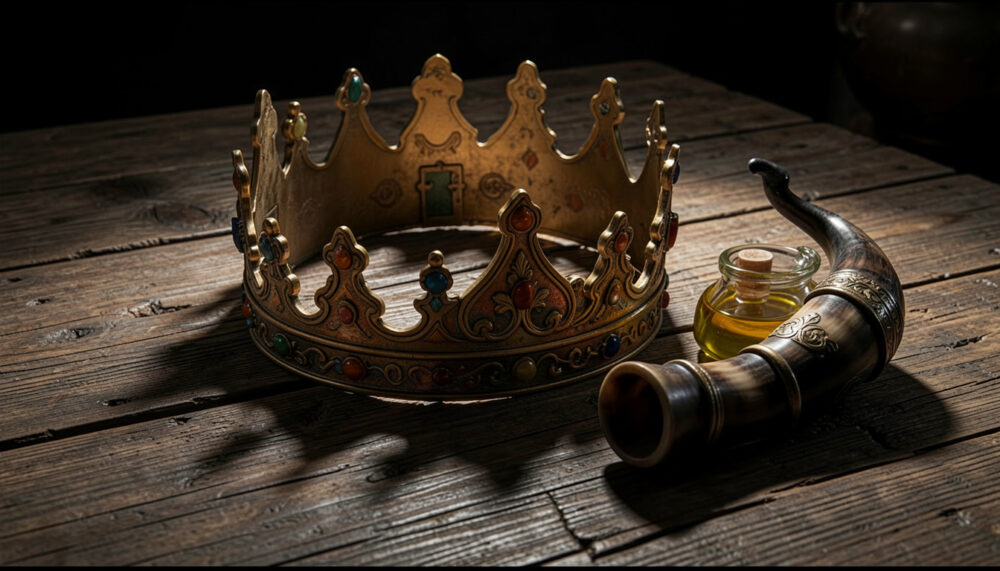
I think we’ve been lied to about what strength really looks like. We’ve been taught that strength is silence. Never bleeding. Never letting anyone see the cracks. Hold it together. Stay in control. Protect your image at all costs. Somewhere along the way, we confused appearance with character and composure with courage. As a result, we’ve raised a generation of Sauls—men who look like kings from a distance. Tall. Capable. Impressive. But bring them close enough to the fire, and you’ll discover something appearance can never hide. The crown begins to melt.
The Bible tells a very different story. And it’s told through the lives of two men who desired the same throne.
Saul looked like a king. Scripture describes him as standing head and shoulders above everyone else, and Israel chose him because of it. David, on the other hand, looked like a mistake—a shepherd boy with dirt beneath his fingernails and a sling hanging from his shoulder. Yet while people were measuring height, God was measuring something entirely different. He wasn’t looking at stature; He was examining the heart.
That is why we are still talking about David today. Not because he was flawless, but because God called him “a man after My own heart” (Acts 13:22). Let that sink in for a moment. This is the same David who committed adultery with Bathsheba, orchestrated the death of one of his own loyal soldiers, failed his children, and left deep scars within his own family. Yet God’s covenant with him remained.
Why?
Because biblical strength is not the absence of failure. It is the condition of your heart after you fail.
1. He Confessed Fast, Without Excuses
When Nathan confronted David about his sin, David didn’t defend himself. He didn’t shift blame or explain away his actions. He simply confessed, “I have sinned against the Lord.” Saul’s response was very different. When Samuel confronted him, Saul immediately pointed to someone else. “The people took the sheep.” One man protected his reputation; the other protected his heart.
Our culture has taught us to manage perception. Protect the brand. Minimise the damage. Offer apologies with escape clauses: “I’m sorry if you felt that way.” David teaches us something far more courageous. Run to God with blood on your hands. Honest confession keeps the heart soft. Saul’s delay turned one act of disobedience into a lost kingdom. David’s immediate repentance turned his darkest moment into Psalm 51.
2. He Was Broken Before God
Saul was always aware of the audience. David was aware of God’s presence. When the Ark returned to Jerusalem, David danced with such uninhibited joy that even his own wife despised him for it. Saul lived for approval. David lived for communion.
We tell men never to cry, never to collapse, never to let anyone see them struggle. Yet Scripture repeatedly says that God is near to the brokenhearted. A man who cannot weep before God will eventually break beneath the weight of leading others. David teaches us that the strongest place a man can stand is often on his knees.
3. He Was Formed in Private
Long before David wore a crown, he learned faithfulness where nobody was watching. No one applauded when he fought the lion. No one celebrated when he killed the bear. No audience heard the songs that later became the Psalms. Those songs were born in lonely fields and dark caves, long before they echoed through a palace.
We live in a generation that wants the platform without the pasture and the influence without the cave. But public authority is only the visible fruit of private formation. God will never entrust a crown to a heart that has not first been shaped in obscurity. Character is forged where applause cannot reach.
4. He Repented Without Negotiating
Saul wanted forgiveness without transformation. David wanted transformation even if it hurt. Saul pleaded, “Forgive me… so I may worship.” David prayed, “Create in me a clean heart, O God.” One wanted the consequences to disappear; the other wanted God to change him from within.
The world has become comfortable with apologies that contain terms and conditions. Biblical repentance does not bargain. It simply says, “I was wrong,” and places the outcome in God’s hands. Vulnerability is not weakness; it is the courage to stand in the wreckage of your own choices without reaching for excuses. That kind of humility is rare. That is why God trusted David.
5. He Remained Teachable
When Samuel rebuked Saul, Saul became defensive. When Nathan pointed his finger at David and declared, “You are that man” (2 Sam 12:7), David became silent. Then he wrote Psalm 51.
Our instinct is often to defend ourselves, question motives, or silence the messenger. David chose another path. He allowed God’s Word to cut deeply because he trusted God to heal completely. Pride destroys crowns, but teachability preserves them. A heart that can still be corrected is a heart that God can still shape.
6. He Fought for God’s Glory, Not His Own
Saul spared the best livestock under the appearance of honouring God, but beneath the surface he was protecting his own image. David approached Goliath with an entirely different motivation. “I come to you in the name of the Lord Almighty.” David wasn’t interested in becoming famous. He wanted Israel to remember who their true King was.
That is the difference between performance and sonship. One seeks recognition; the other seeks God’s glory. The world tells us to protect our reputation at all costs. Biblical strength is willing to lose reputation if it means God’s name is honoured.
7. He Chose Mercy & Humility Over Victory
Saul spent years hunting David to preserve his throne. Twice David had the opportunity to end Saul’s life. Once inside a cave, and once while Saul slept. No one would have condemned him for taking the kingdom by force. Instead, David merely cut the corner of Saul’s robe, and even that troubled his conscience. Later he cried across the valley, “Why does my lord pursue a dead dog? Why pursue a flea?” before declaring, “The Lord forbid that I should lay my hand on the Lord’s anointed.”
That is not weakness. That is strength under control. Real strength is not the ability to destroy your enemy; it is possessing that power and choosing mercy instead. Saul wanted to win. David wanted to honour God.
8. He Kept His Word When No One Was Watching
Years after Jonathan’s death, David asked a remarkable question: “Is there anyone still left of the house of Saul to whom I can show kindness for Jonathan’s sake?” (2 Samuel 9:1). Jonathan was gone. Saul was gone. The political threat had disappeared. No one would have criticised David for forgetting an old promise.
Yet David searched until he found Mephibosheth, Jonathan’s crippled son, and welcomed him to eat continually at the king’s table.
That is biblical strength. Not merely showing mercy to enemies, but remaining loyal to friends even after the world has moved on. We live in an age of broken promises and abandoned covenants. David honoured a promise made to a dead friend by caring for a forgotten son. A man after God’s heart doesn’t merely lead well; he loves faithfully long after the applause has faded.
9. He Paid for Every Sacrifice
Perhaps nothing reveals David’s heart more clearly than the final great failure of his life. In pride, he numbered Israel, and seventy thousand people died. When God instructed him to build an altar on Araunah’s threshing floor, Araunah generously offered to give him everything he needed free of charge.
David refused.
“I will not offer to the Lord my God sacrifices that cost me nothing.” (2 Samuel 24:24)
So he paid the full price.
Then he worshipped.
And the plague stopped.
Saul blamed others whenever he failed. David accepted responsibility even when the consequences were devastating. Real men do not outsource repentance. They do not search for the cheapest path back to obedience. When you have caused damage, you build the altar yourself. You pay the cost. Because worship that costs nothing changes nothing.
10. He Finished by Pointing to Someone Greater Than Himself
Every king eventually faces the same temptation: to build his own kingdom.
David certainly wasn’t perfect, but one thing set him apart. He understood that the throne was never ultimately about him.
Near the end of his life, David didn’t try to establish his own greatness. Instead, he devoted enormous energy and resources to preparing for the temple that Solomon would build. God had told David that he would not build it because he was a man of war (1 Chronicles 22:8), yet David didn’t become bitter or resentful. He gathered gold, silver, timber, stone, craftsmen, musicians, priests, and detailed plans so that the next generation could succeed.
David was willing to spend his life preparing something he would never see completed.
That is rare.
Most people want to build monuments to themselves. David prepared a house for God.
Even more remarkable is that God had already promised David that one of his descendants would reign forever. David understood that the kingdom was always pointing beyond himself to the coming Messiah. His greatest legacy wasn’t the kingdom he built—it was the King who would one day come from his line.
A man after God’s heart doesn’t spend his life making his own name famous. He spends it preparing the way for God’s Kingdom. That is why David remains the pattern of biblical kingship. His crown ultimately pointed to another crown.
To Jesus.
So What’s the Condition of Your Crown? Your crown is coming. Perhaps it will be called fatherhood. Perhaps leadership. Perhaps your marriage, your business, your ministry, or the influence God places into your hands. The question is not whether responsibility will come. The question is whether your heart is ready to carry it.
Saul lost his crown because his heart refused to bend. David kept his because his heart broke, repented, and bent back toward God. God is not searching for flawless men. He is looking for surrendered men—men who will fail, confess, repent, worship, rise again, and keep following Him. The world tells men to protect their image. God tells men to guard their hearts.
“Above all else, guard your heart, for everything you do flows from it.” (Proverbs 4:23)
That is the real condition of every crown. One crown looked stronger. The other was stronger.
One man spent his life protecting his reputation. The other spent his life guarding his heart. One kingdom was torn away. The other became the blueprint for the King who was yet to come.
Every crown has a condition. Before you ask God for a bigger platform, ask Him for a softer heart.
Because crowns are rarely lost in public. They are first lost in private.
And the condition of your crown has always been the condition of your heart.