
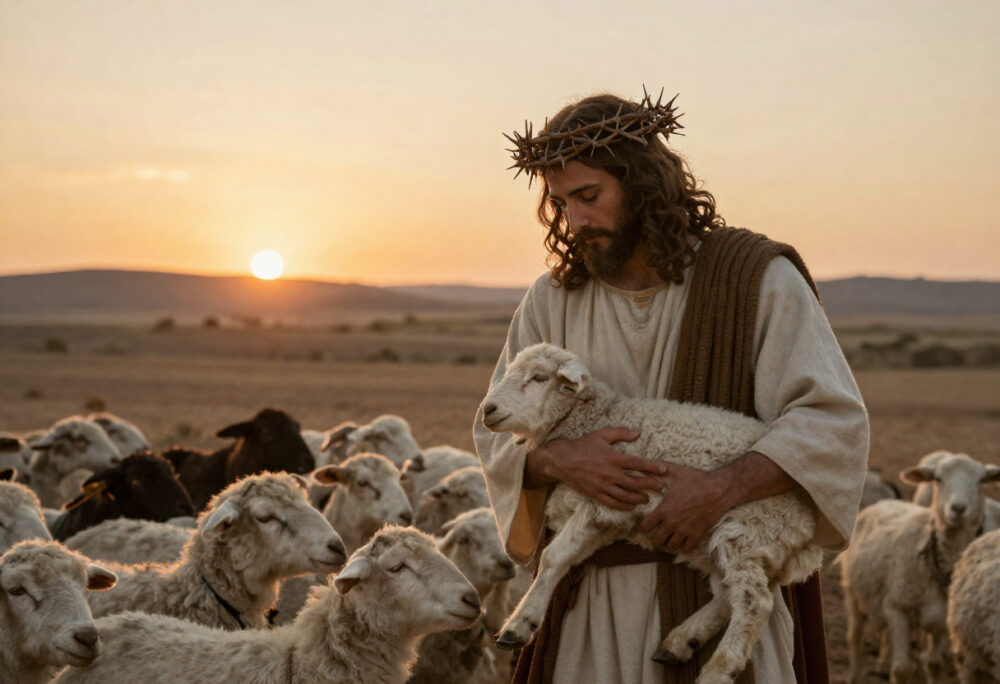
The Ultimate Paradox of Leadership
In ancient Israel, kings did not wear crowns of gold; they carried staffs of wood. To rule a nation was to shepherd a people. Throughout Israel’s history, the “shepherd” was the ultimate symbol of authority, responsibility, and protective care.
Yet, the history of Israel is largely a story of broken staffs and scattered flocks. It is a history that sets the stage for the most shocking paradox in spiritual history: the arrival of a Great Shepherd who secures His throne not by driving off the wolves, but by allowing Himself to be slaughtered like a lamb by them.
The Historical Anatomy of Israel’s Shepherds
To understand this paradox, one must understand what shepherding meant to an ancient Israelite. A good shepherd was a fierce protector and a selfless provider. They lived with the flock, smelled like the flock, and risked their lives against lions and bandits. They knew each animal’s weaknesses and called them by name.
A bad shepherd, conversely, was a political opportunist. In Israel’s history, this role was tragically filled by corrupt kings, priests, and prophets. Instead of protecting the vulnerable, these leaders exploited them. They used their authority for personal luxury, leaving the nation vulnerable to foreign empires—the physical “wolves” of Assyria and Babylon.
The Prophetic Indictment: Ezekiel, Jeremiah, and Zechariah
By the time the Old Testament prophets took the stage, the systemic failure of Israel’s leadership had reached a breaking point. God issued fierce indictments through His messengers, laying the groundwork for a radical intervention.
1. The Exploitative Rulers (Ezekiel 34)
Through Ezekiel, God unleashes a scathing critique of Israel’s elite:
“Woe to you shepherds of Israel who only take care of yourselves! Shouldn’t shepherds take care of the flock? You eat the curds, clothe yourselves with the wool and slaughter the choice animals, but you do not take care of the flock.” (Ezekiel 34:2–3)
Because of these predatory leaders, the flock was scattered across the mountains, left as meat for wild beasts. God’s response is a promise of divine regime change: “I myself will search for my sheep and look after them… I will rescue them from their mouths.”
2. The Judgment of the Scattered (Jeremiah 23)
Jeremiah echoes this heartbreak, shouting, “Woe to the shepherds who are destroying and scattering the sheep of my pasture!” (Jeremiah 23:1). But amid the wreckage of exile, Jeremiah drops a seed of explosive hope. God promises to gather the remnant of His flock, bring them back to their pasture, and raise up a righteous “Branch” from the line of David who will rule wisely and do what is just.
3. The Rejected Worth (Zechariah 11)
Perhaps the most haunting background comes from Zechariah 11. The prophet is told to act out the role of a good shepherd to a flock doomed to slaughter. When he asks for his wages, the people insultingly hand him thirty pieces of silver—the price of a common slave. Zechariah breaks his pastoral staffs, symbolising the severed covenant and the terrible reality that when Israel was given a true shepherd, they despised him.
This prophetic rejection finds its literal, chilling fulfilment in the betrayal of Jesus by Judas Iscariot. When Judas approaches the corrupt religious leaders—the bad shepherds of his day—they negotiate his payment at exactly thirty pieces of silver (Matthew 26:15). Zechariah even prophesied what would happen to the money: it would be thrown into the house of the Lord to the potter. When a guilt-ridden Judas later flings the coins back into the Temple, the priests use them to buy the Potter’s Field (Matthew 27:3–10). The price tag placed on the Good Shepherd’s life was the exact valuation of a rejected slave.
The Great Pivot: Isaiah’s Silent Sacrifice
For centuries, Israel waited for the divine Shepherd of Ezekiel 34 and Jeremiah 23 to arrive with military might, break the nations with an iron rod, and punish the bad shepherds. They expected a conqueror.
Instead, the prophet Isaiah introduced a jarring, incomprehensible twist in the narrative. In Isaiah 53, the human condition is diagnosed using the familiar pastoral metaphor: “We all, like sheep, have gone astray, each of us has turned to our own way” (Isaiah 53:6). We are the scattered flock of Ezekiel’s nightmare.
But how does God choose to gather us? Not by sending a shepherd who slays the wolves, but by sending a Servant who absorbs the strike:
“He was oppressed and afflicted, yet he did not open his mouth; he was led like a lamb to the slaughter, and as a sheep before its shearers is silent, so he did not open his mouth.” (Isaiah 53:7)
Here, the imagery collides. The Sovereign Shepherd promised throughout Israel’s history enters the human arena and steps into the skin of the Passover Lamb.
The Collision: John 10 and the Feast of Dedication
The spiritual and historical threads of Ezekiel, Jeremiah, Zechariah, and Isaiah collide explicitly in John 10. Here, the Apostle John provides a highly specific setting that acts as the perfect pressure cooker for Jesus’ claims:
“Then came the Feast of Dedication at Jerusalem. It was winter, and Jesus was in the temple courts walking in Solomon’s Colonnade.” (John 10:22–23)
The Feast of Dedication (known today as Hanukkah) was an intensely patriotic winter festival. It celebrated the historic victory of the Maccabees, who had successfully revolted against a tyrannical foreign king, cleansed the defiled Temple, and rededicated its altar [John 10:22].
However, the festival also carried a dark underside. The Hasmonean dynasty born from that revolution had eventually devolved into a line of deeply corrupt, politically driven priest-kings—the exact definition of the “bad shepherds” condemned by the prophets. Furthermore, because it celebrated a military coup, the winter air was thick with political tension. The crowd was desperately looking for a new, militant leader to overthrow Rome and restore the temple.
When Jesus stands in the Temple during that winter chill, the crowd demands a political warrior: “If you are the Messiah, tell us plainly” (John 10:24). They wanted a shepherd who would pick up a sword and slaughter the Romans, just like the Maccabees did.
Instead, Jesus gives them a paradox that sounded like absolute foolishness to an ancient audience: “I am the good shepherd. The good shepherd lays down his life for the sheep” (John 10:11).
In standard warfare or shepherding, a dead leader is a failed leader. If the shepherd dies, the wolves win and the sheep are destroyed. But Jesus was operating on a cosmic calculus. The ultimate threat to God’s flock was not Roman oppression, but the terminal disease of sin and spiritual death. To defeat that predator, a military revolt would not suffice. A spotless sacrifice was required. Jesus wields His pastoral authority not by taking life, but by giving it. He allows Himself to be bound, silenced, and slaughtered like a Passover Lamb. In doing so, His spilled blood becomes the ultimate boundary line, protecting His flock from the final judgment of death.
The bad shepherds of Israel’s history—celebrated yet flawed at the Feast of Dedication—fed on the sheep to sustain themselves. The Good Shepherd feeds the sheep with His own broken body. Standing in Solomon’s Colonnade, Jesus reveals that He is the Ruler who serves, the Guardian who bleeds, and the Shepherd who became the Lamb so that His wandering flock could finally come home.
The Crucial Conclusion: The Blueprint for Kingdom Leadership
Jesus completely redefines what it means to be a spiritual leader: to qualify as a shepherd, one must first learn to be a lamb.
In God’s kingdom, leadership is not based on rank, charisma, or power, but on the condition of the heart. The Apostles later took this exact concept and used it to warn the early Church that while many want to be shepherds, their hearts reveal whether they are true protectors or dangerous counterfeits. The Apostle Peter, writing to local elders, urged them to protect the flock “not because you must, but because you are willing… not lording it over those entrusted to you, but being examples to the flock” (1 Peter 5:2-3). Meanwhile, the Apostle Paul fiercely warned the elders of Ephesus to guard themselves and the church, stating that after his departure, “savage wolves will come in among you and will not spare the flock” (Acts 20:29). Even Peter echoes this caution against leaders driven by greed, explicitly warning against those who exploit the people for “dishonest gain” (1 Peter 5:2).
Here is how Jesus’ identity as the Lamb sets the standard for all who wish to shepherd, and how the condition of the heart separates the good from the bad.