
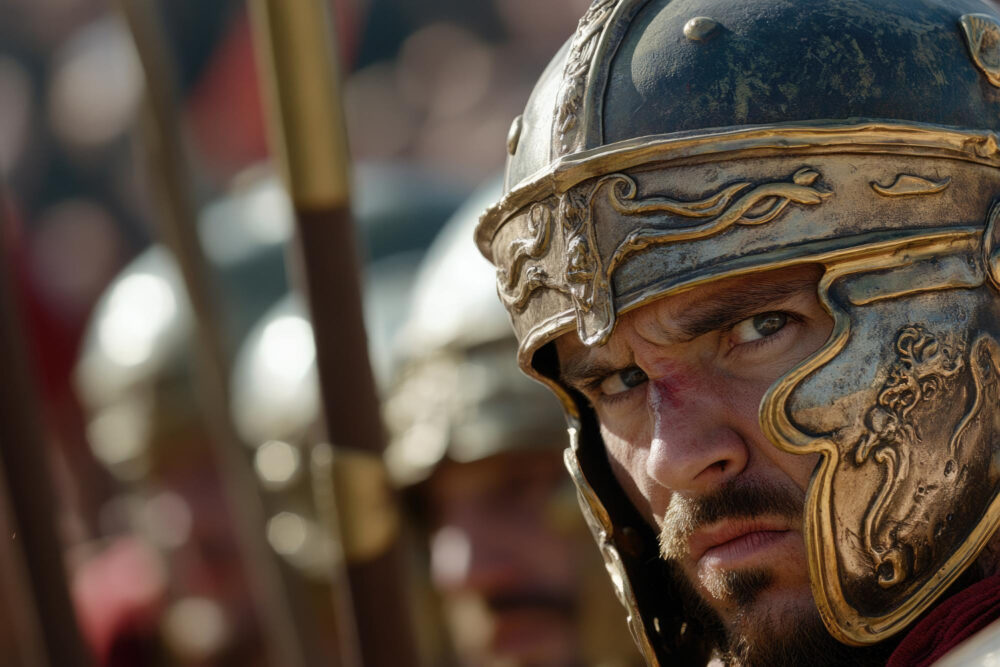
For generations, the standard interpretation of the Armour of God in Ephesians 6:10–18 has been viewed through the lens of a Roman legionnaire. Because Paul was writing from a Roman prison, it is often assumed he looked at the guard chained to his wrist and moralized his military equipment.
However, this conventional view fundamentally misinterprets Paul’s theological training and literary intent. As a Pharisee trained under Gamaliel (Acts 22:3), Paul did not look to pagan Rome for his theology of spiritual defense. Instead, his description draws directly from the Hebrew Scriptures, the Levitical priesthood, and the prophetic imagery of Yahweh dressing for vindication.
By examining the original Greek verbs, the Septuagint (the Greek Old Testament), and Ancient Near Eastern thought, we uncover a profound reality: the Armour of God is not a call to human military aggression, but an invitation to step into the consecrated garments of the High Priest and the Messianic Warrior-King.
1. The Blueprint of Victory: Standing in the Secured Triumph
Before analyzing the individual garments, we must understand the Hebrew concept of spiritual warfare. In Western thought, armour implies a pending battle where the outcome hangs in the balance. In Hebrew thought, the battle is entirely the Lord’s, and His people are called to occupy a victory already achieved.
This structural blueprint is perfectly illustrated in 2 Chronicles 20. Confronted by an overwhelming coalition of hostile armies, King Jehoshaphat did not mobilize traditional military strategies. Instead, the prophet Jahaziel delivered a counter-intuitive divine command that mirrors Paul’s instruction in Ephesians:
“You will not need to fight in this battle. Position yourselves, stand still and see the salvation of the Lord with you… Do not fear or be dismayed; tomorrow go out against them, for the Lord is with you.” — 2 Chronicles 20:17
The Hebrew word for “position yourselves” (hityasbu) is an active, stationary command. The following morning, Jehoshaphat appointed singers to walk ahead of the army, dressed in holy attire (hadrat-kodesh), singing praises to God (2 Chronicles 20:21). When they reached the lookout, the enemy forces had already destroyed one another.
This is the exact posture Paul commands in Ephesians 6:13: “take up the whole armor of God… and having done all, to stand firm.” Believers do not fight for victory; like the robed singers of Judah, they dress in the garments of the sanctuary to stand in a victory already secured by God.
2. Deep-Dive: The Six Priestly Vestments of God
Ⅰ. Girding the Waist with Truth (The Abnet vs. The Zōnē)
Modern translations typically state, “buckle the belt of truth around your waist.” This instantly brings to mind the heavy Roman leather utility belt (zōnē) used to secure weapons. However, Paul deliberately bypasses the noun for a physical belt.
Instead, he uses the verbal action-idiom perizonnymi (περιζωσάμενοι), meaning “having bound or wrapped around oneself,” applied to the osphys (ὀσφὺν), the loins or lower midsection. Paul is directly quoting the Hebrew idiom for “girding one’s loins.”
- The Old Testament Imagery: In ancient Israel, men wore long, flowing robes. To run, work, or engage in immediate activity, a man had to pull the hem of his tunic up through his thighs and tuck it securely into his waistband to eliminate tripping hazards. We see this vividly in 1 Kings 18:46, where Elijah “girded up his loins” to outrun King Ahab’s chariot in a divine display of agility and readiness.
- The Priestly Narrative: More significantly, the waistband was a defining feature of the priesthood. In Leviticus 8:7, Aaron was bound with the abnet, a beautifully woven, wrapping sash. Furthermore, Isaiah 11:5 prophesies that the Messiah would be clothed this way: “Righteousness shall be the belt of his waist, and faithfulness the belt of his loins.”
- Hebrew Thought Application: To “gird your waist with truth” means pulling up the loose, trailing ends of your life—your anxieties, cultural distractions, and double-minded thoughts—and tying them down tightly to God’s objective truth. It is an act of spiritual discipline that prevents you from tripping over your own garments when God calls you to move.
Ⅱ. The Breastplate of Righteousness (The Choshen vs. The Lorica)
The Roman lorica segmentata (iron chest armor) was designed to deflect physical blades and project military dominance. Paul shifts the focus entirely by calling it the thōrax of righteousness, directly referencing the Greek Septuagint translation of Isaiah 59:17:
“He put on righteousness as a breastplate [thōrax], and a helmet of salvation on His head…”
- The Old Testament Imagery: In Isaiah 59, Yahweh looks at a broken world devoid of justice, sees that there is no human intercessor, and steps into the fray Himself. The armor belongs uniquely to God; it represents His sovereign character and unyielding justice.
- The Priestly Narrative: In the sanctuary context, this chest piece corresponds directly to the High Priest’s Breastpiece of Judgment (choshen mishpat) detailed in Exodus 28:15–30. This sacred vestment was adorned with twelve precious stones representing the tribes of Israel and housed the Urim and Thummim (meaning “Lights and Perfections”), through which the divine will of God was mediated.
- Hebrew Thought Application: The priest wore the names of God’s people over his heart to signify that they were kept and protected by divine decree. When a believer puts on the breastplate of righteousness, they are not relying on their own flawed moral performance. They are sliding behind the protective, imputed righteousness of Jesus Christ, our Great High Priest. It protects our emotional and spiritual core from the lethal accusation that we do not belong to God.
Ⅲ. Feet Shod with the Readiness of the Gospel of Peace
The conventional view links this piece to the Roman caligae—heavy leather sandals studded with sharp iron nails to help a soldier trample his foes and maintain his footing in the mud. However, the Old Testament priestly narrative turns this completely upside down.
- The Old Testament Imagery: Paul explicitly quotes the joyful declaration of Isaiah 52:7: “How beautiful upon the mountains are the feet of him who brings good news, who publishes peace, who brings good news of happiness, who publishes salvation, who says to Zion, ‘Your God reigns.'”
- The Priestly Narrative: According to Exodus 28, Leviticus 8, and the implicit temple records, Old Testament priests served in the Tabernacle completely barefoot. God commanded Moses at the burning bush (Exodus 3:5) and Joshua at Jericho (Joshua 5:15) to remove their shoes because the presence of God makes the ground holy.
- Hebrew Thought Application: In Hebrew thought, the temple floor was holy ground, and the priests walked barefoot because human, worldly footwear was forbidden in the presence of Yahweh. The term Paul uses for “readiness” (hetoimasia) implies a firm foundation or a prepared state. The priest’s footing does not come from spiked combat boots that aggressively grip the dirt to trample an enemy; it comes from standing on ground that has already been sanctified and secured by God. We walk in peace because the territory has already been won.
Ⅳ. The Shield of Faith (The Divine Pillar vs. The Scutum)
The Greek word Paul uses is thyreos (θυρεόν), which derives from thyra (a door). It does not refer to the small, circular buckler (aspis), but to the massive, rectangular shield that guarded the entire body. Roman soldiers covered these wooden shields in wet leather to extinguish flaming arrows dipped in pitch.
In Hebrew thought, however, a shield is never a piece of fragile, human-made military gear.
- The Old Testament Imagery: Throughout the Psalms and Torah, Yahweh repeatedly defines Himself as the ultimate shield of His covenant people. In Genesis 15:1, God comforts Abraham, saying, “Do not be afraid, Abram. I am your shield.” Psalm 3:3 declares, “But You, O Lord, are a shield around me,” and Proverbs 30:5 states, “He is a shield to those who take refuge in Him.”
- The Priestly Narrative: The ultimate manifestation of this “door-shaped shield” in Israel’s history was the Pillar of Cloud and Fire. In Exodus 14:19–20, as the Egyptian army closed in on the defenseless Israelites at the Red Sea, the Angel of God and the Pillar of Cloud shifted positions, moving from the front to the rear. It stood as a massive, protective firewall between the enemy and God’s people, absorbing every incoming assault.
- Hebrew Thought Application: Faith is not a personal psychological shield that we must awkwardly hold up with a tired arm. Faith is the act of stepping behind the massive, unyielding doorway of God’s personal presence and covenant promises. The flaming darts of the enemy do not test the strength of our willpower; they break harmlessly against the absolute faithfulness of Yahweh.
Ⅴ. The Helmet of Salvation (The Mitre vs. The Kranos)
The classical Greek language has a standard military word for a heavy bronze battle helmet: kranos (κράνος). If Paul wanted to evoke the image of a Roman soldier’s skullcap, kranos would have been the precise term.
Instead, Paul deliberately rejects kranos and chooses perikephalaia (περικεφαλαία), a descriptive compound word meaning “that which completely encircles and wraps around the head.” He does this to maintain direct continuity with the Greek Septuagint translation of Isaiah 59:17 (perikephalaia sōtēriou).
- The Old Testament Imagery: This choice anchors the head covering back into the context of the sanctuary. In Isaiah 61:10, the prophet rejoices: “He has clothed me with the garments of salvation… as a bridegroom decks himself like a priest.” The original Hebrew verb used here for “decking oneself” is yekahen, which literally means “to priest it” or “to officiate as a priest.”
- The Priestly Narrative: The perikephalaia—the total encirclement of the head—parallels the High Priest’s Turban (mitre or kidaris) described in Exodus 28:36–41. Fastened directly to the front of this turban, resting squarely upon the priest’s forehead, was a plate of pure gold engraved with the words: “Holy to the LORD” (Kodesh la-YHWH).
- Hebrew Thought Application: According to Exodus 28:38, this plate sat on the priest’s forehead specifically so that he would “bear any guilt” concerning the sacred gifts, making the people “acceptable before the Lord.” The forehead represents the mind, identity, and thoughts. The Helmet of Salvation is the priestly assurance of absolute acceptance. It seals the believer’s mind against condemnation, self-doubt, and fear by reminding them that they bear the name, identity, and holiness of Christ on their brow (Revelation 22:4).
Ⅵ. The Sword of the Spirit (The Sacrificial Knife vs. The Gladius)
Finally, Paul introduces the only offensive instrument: “the sword of the Spirit, which is the word of God.” The standard Roman battlefield sword was the rhomphaia (a massive, heavy broadsword) or the gladius. Paul chooses neither.
Instead, he uses the word machaira (μάχαιρα).
- The Old Testament Imagery: While machaira can mean a short sword or dagger in secular contexts, its primary usage in the Greek Septuagint and temple vocabulary is the priestly sacrificial knife or scalpel. This is the exact word used in Genesis 22:6 when Abraham lifted the knife (machaira) to offer Isaac on Mount Moriah. It is the tool used by the Levitical priests to slaughter, skin, and precisely dissect sacrificial animals.
- The Priestly Narrative: A sacrificial machaira was never used to aggressively hack down political enemies on a battlefield. It was an instrument of precision, used to separate the fat from the meat and expose the internal condition of the offering before God.
- Hebrew Thought Application: This priestly context clarifies the famous passage in Hebrews 4:12: “For the word of God is living and active, sharper than any two-edged sword [machaira], piercing to the division of soul and of spirit, of joints and of marrow, and discerning the thoughts and intentions of the heart.” The Word of God is not a weapon of human slaughter designed to tear others apart. It is a holy, sharp, priestly instrument of internal spiritual surgery. It cuts away our carnal nature, exposes our true motives, splits open our pride, and brings spiritual life out of death by aligning us with God’s covenant.
3. The Garments of Light: Overcoming the Flesh Without Sweat
To seal this entire priestly narrative, we must look at the material composition of this armor. In Ezekiel 44:17–18, God gives strict, eternal instructions for priests operating within the inner court of His sanctuary:
“They shall be clothed with linen garments; no wool shall come upon them while they minister… They shall have linen turbans on their heads, and linen undergarments around their waists. They shall not gird themselves with anything that causes sweat.“
In Hebrew thought, sweat is the primordial symbol of the curse of the Fall—it represents human striving, independent effort, and fleshly toil (Genesis 3:19). God explicitly forbids His priests from sweating in His presence.
This is the ultimate secret of the Armour of God. If the armour were Roman, it would be heavy, exhausting, and require immense physical strength and human sweat to carry into battle. But because the armor is priestly and composed of light (Romans 13:12), it requires no human sweat. Believers do not achieve victory through strenuous fleshly striving; they step into the finished, effortless intercession of Jesus Christ.
As Paul concludes in Ephesians, we wrap ourselves in this divine attire not to charge into a bloody battlefield, but to stand firm as consecrated ministers of reconciliation, radiating the secured victory of our King.
Conclusion: Stepping Into the Sanctuary of Victory
The traditional view of the Armour of God leaves many believers exhausted. It paints a picture of a grueling, never-ending infantry battle where our safety depends entirely on how tightly we grip our shields or how aggressively we swing our swords. It is a paradigm built on human sweat, heavy iron, and constant fear of the next assault.
But when we pull back the Roman curtain and look through the eyes of Hebrew Scripture, the landscape changes entirely.
The battlefield becomes a sanctuary. The heavy iron transforms into pure linen. We discover that we are not isolated soldiers left to defend ourselves on a muddy battlefield; we are a royal priesthood called to minister in a kingdom that has already been won. Every piece of armor Paul describes is a piece of clothing worn by Yahweh Himself, handed down to us through the finished work of Yeshua our Great High Priest.
We do not put on this armour to fight for a position of safety; we wear it because we are already safe. Like King Jehoshaphat’s singers in the wilderness of Tekoa, our primary strategy is to put on the beautiful garments of holiness, stand firm on holy ground, and watch the salvation of the Lord.
The enemy’s greatest weapon is to convince you that you are still fighting an undecided war in your own strength. Do not fall for the Roman deception. Cast off the heavy, sweat-inducing armor of fleshly striving, step out of the secular battlefield, and put on the garments of light. Your King has already triumphed over the powers of darkness—stand still, rest in His presence, and occupy His victory.