
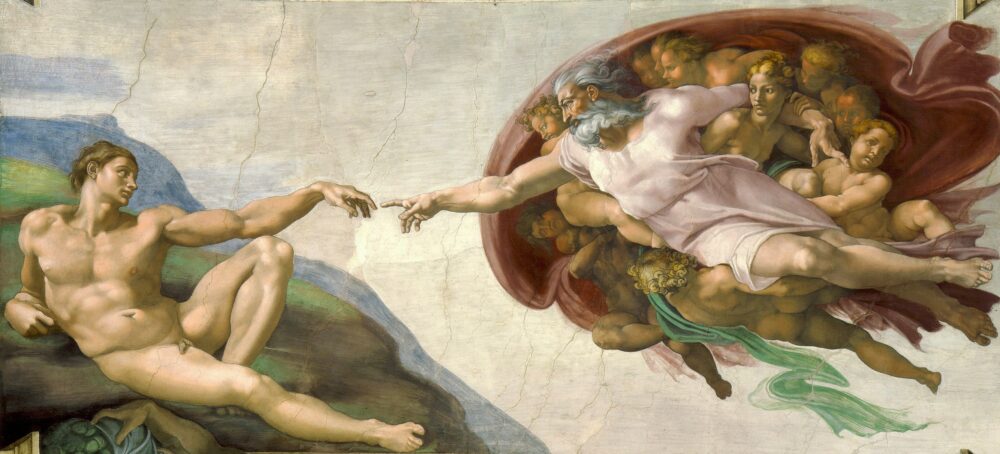
The concept of the human-trinity—that a person is composed of a body, soul, and spirit—is widely taught in theology, but does the Bible actually endorse this idea? A closer look at Scripture reveals that the distinction may not be as clear as some believe.
The only instance where the combination of “body, soul, and spirit” is mentioned together is in 1 Thessalonians 5:23, where the apostle Paul refers to a person as a complete, undivided being. The traditional Hebrew understanding of a person’s composition upon death differs significantly. For them, death was the reversal of creation. The body returns to dust (Gen 2:7, Job 10:9), and the spirit goes back to God, who gave it (Ecclesiastes 12:7, Job 32:8). The soul, or nephesh, enters the realm of the dead (Sheol or Paradise) (Ps 16:10, Acts 2:27) and is no longer a living, breathing entity, in line with Genesis 2:7, which states “man became a living being” [Gen 2:7]. [Rev 20:5]
In ancient times, without modern medical knowledge, people determined life by one key sign: breath (Ps 104:29, 146:4). Life was understood as the presence of God’s breath (ruach in Hebrew) within a person or animal (Job 33:4, 34:14-15), enabling them to fulfil their purpose on earth.
Linguistic Insights: A Look at Biblical Terms
| Bible Language | Body | Soul | Spirit |
|---|---|---|---|
| Old Testament Hebrew | Basar (בָּשָׂר) – FLESH | Nephesh (נֶפֶשׁ) – BREATHING | Ruach (רוּחַ) – BREATH |
| New Testament Greek | Soma (σῶμα) – BODY | Psyche (ψυχή) – BREATHING | Pneuma (πνεῦμα) – BREATH |
To grasp how the Bible views human nature and the mechanics of death, think of a standard household hairdryer. It consists of three interdependent components:
- The Body (The Machine): This is the physical shell made of plastic, metal, and heating elements. On its own, it is completely cold, inert, and motionless. This represents the “dust of the earth” formed by God [Gen 2:7].
- The Spirit (The Electricity): This is the raw power flowing from the wall outlet. The electricity doesn’t have a face, a name, or a personality. It belongs entirely to the main power grid. This is the Ruach—the “borrowed” or “lent” breath of life from God [Eccl 12:7].
- The Soul (The Blowing Function): The act of blowing warm air is the hairdryer’s soul. It isn’t a physical piece you can unscrew, nor is it the raw electricity itself. It is a dynamic function that only exists when the physical machine is plugged into the power source. This is the Nephesh—the conscious mind, personality, and identity [Gen 2:7].
What Happens When You Unplug It?
When you pull the plug on the hairdryer, where does the “blowing function” (the soul) go? It doesn’t fly up to the ceiling, nor does it hide inside the wall socket. It simply ceases to happen. Furthermore, it goes into absolute stasis. The plastic machine sits cold on the counter (the grave), and the electricity reverts to the power grid (God).
The Interchangeability of Soul and Spirit
One of the most compelling arguments for the dichotomist position—that the soul and spirit are not distinctly different parts—is how the Bible often uses these terms interchangeably. If they were separate, it should be possible to define distinct roles for each. However, the New Testament frequently attributes the same actions and attributes to both. This suggests they are simply two different ways of referring to the same non-physical aspect of a person. The proverb in Proverbs 20:27 further supports this, stating, “The spirit of man [that factor in human personality which proceeds immediately from God] is the lamp of the Lord, searching all his innermost parts.”
Consider these scriptural examples:
- Troubled state: Jesus is troubled in his soul (John 12:27) and his spirit (John 13:21).
- Rejoicing: Mary’s soul and spirit both rejoice in God (Luke 1:46–47).
- Death: Death is described as the departure of both the soul (Luke 12:20) and the spirit (Luke 23:46, 7:59).
- Described together: Humans are described as both “body and soul” (Matthew 10:28) and “body and spirit” (1 Corinthians 5:5, James 2:26).
- Sin: Sin can be with the soul (Revelation 18:14) or with the spirit (2 Corinthians 7:1).
- Knowing thoughts: Jesus knows thoughts through his spirit (Mark 2:8), and a person’s spirit knows their own thoughts (1 Corinthians 2:11).
- Loving God: A person’s soul longs for God (Psalm 42:1–2), and their spirit rejoices in God (Luke 1:47).
The New Testament’s Varied Language
The Bible uses a wide variety of terms to describe the physical and non-physical aspects of a person, which cautions against an overly technical interpretation (Hebrews 4:12). The different combinations include:
- “Spirit and soul and body” (1 Thessalonians 5:23)
- “Body and spirit” (1 Corinthians 7:34)
- “Soul and body” (Matthew 10:28, 27:52)
- “Body” and “spirit” (James 2:26)
- “Heart,” “soul,” “strength,” “mind” (Luke 10:27)
- “Heart,” “soul,” “mind” (Matthew 22:37)
- “Bodies” and “mind” (Romans 12:1–2)
This rich variety of terms, such as in Jesus’ command to love God with all your heart, soul, strength, and mind (Luke 10:27), emphasises loving God with every fibre of your being, not that a person is made of four distinct parts.
The Meaning of Soul and Spirit
To grasp the biblical meaning of these terms, we can look to Genesis 2:7, where “the LORD God formed the man of dust from the ground and breathed into his nostrils the breath or spirit of life, and man became a living being.” This act provided the body, perfectly designed by God. This “breath of life” is the soul, which transformed a clay statue into a person capable of thought, worship, reason, and action. The soul, therefore, is the animating principle that turns a physical form into a conscious being.
The term “spirit,” when referring to the non-physical part of a person, is often used in connection with the Holy Spirit’s interaction with believers. For example, 1 Corinthians 6:17 states that “he who is joined to the Lord becomes one spirit with him.” While Paul could have used the term “soul,” “spirit” more aptly captures the unique unity that forms between a believer’s spirit and the Holy Spirit at conversion.
In summary, the Bible’s language suggests that the soul and spirit are not separate components of a person but are different ways of describing the same inner, non-physical self. This understanding is further reinforced by passages on resurrection (1 Cor 15:20, 51-55, Dan 12:2) and final judgment (Heb 9:27). This helps clarify the interchangeability of the terms in Scripture.